Sunday 03 / May / 2026
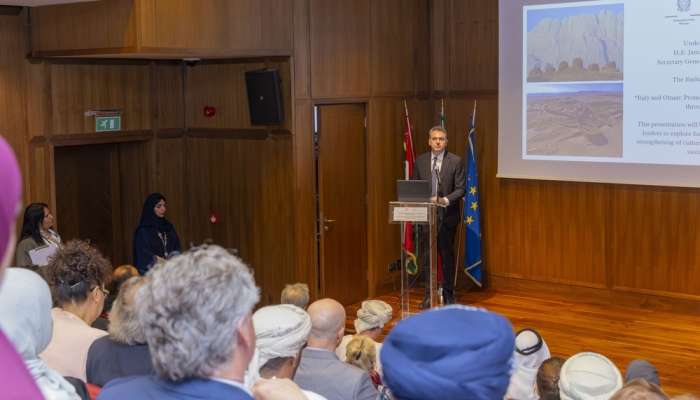
Muscat--- The National Museum Represented by the Learning Centre, and in cooperation with the Embassy of the Italian Republic in Muscat, organised today an event titled “Italy and Oman Promoting Tourism and Cultural Identity through Archaeology”.
The event was held under the auspices of Jamal Hassan Al Moosawi, Secretary-General of the National Museum, and was attended by a number of ambassadors, distinguished group of experts and specialists in the fields of archaeology, tourism, and culture, along with academics, students from the College of Tourism and individuals interested in cultural and historical affairs.
This event aims to open avenues for dialogue and exchange of expertise among specialists, contributing to the development of joint initiatives that enhance the status of cultural heritage as a key resource supporting comprehensive development. They also reaffirm its role in strengthening national identity, fostering cultural openness, and enhancing cultural cooperation between the Sultanate of Oman and the Italian Republic, while highlighting the importance of archaeology as a fundamental pillar in preserving cultural identity and its vital role in supporting the sustainable tourism sector, reflecting the civilizational value of human heritage.
The event commenced with a speech delivered by Pierluigi D’Elia, Ambassador of Italy to the Sultanate of Oman, in which he expressed his great appreciation for today’s conference highlighting the fruitful collaboration done by Italian professors and archeologists and their colleagues from Oman on the sound basis of a cooperation dating back to half a century. The Italian Ministry of Foreign Affairs and the Embassy of Italy strongly support this common work.
Dr. Fatma Mohammed Al Balushi, Adviser to the Secretary-General for Museum Affairs at the National Museum, delivered a working paper titled “Contribution of the National Museum in Highlighting the Role of Italian Missions in the Study of Oman Archaeology”.
In her presentation, she reviewed the National Museum’s efforts in showcasing the work of Italian archaeological missions in the Sultanate of Oman, as well as the areas of bilateral cooperation between the National Museum and the Italian Republic. This includes the organisation of joint exhibitions, lectures, and joint cultural activities, emphasising the importance of strengthening such cooperation as a tool of cultural diplomacy that effectively contributes to preserving Omani cultural heritage and enhancing its presence at both regional and international levels.
Tommaso d'Errico, Honorary Consul of the Sultanate of Oman in Florence, Italian Republic, also delivered a working paper on the architectural legacy of his father, Architect Enrico D'Errico, in Oman’s architectural heritage, entitled “Omani Forts and Castles: Their Historical and Architectural Role”.
He reviewed the historical and engineering value of Omani forts and castles, noting their multiple functions beyond defence, as centres of governance, education, and daily life. He also highlighted notable examples of forts such as Adam, Jabrin, and Khasab, and castles including Bahla, Al-Mirani, and Muttrah, in addition to the historic site of Qalhat, as living testimonies to the development of Omani architecture, its interaction with the environment, and as tourism assets reflecting the deep-rooted civilisation of the Sultanate of Oman.
Prof. Sara Pizzimenti, Associate Professor of Archaeology at the University of Pisa, Italian Republic, and Professor Khalid Ahmed Douglas, Professor of Archaeology at Sultan Qaboos University, both members of the joint mission between Sultan Qaboos University and the University of Pisa, presented findings from archaeological excavations at the al-Taykha site in the Wilayat of A’Rustaq.
The site is considered one of the largest settlements of the Umm an-Nar culture, covering more than (70) hectares and dating back to the third millennium BCE. Fieldwork has revealed a complete settlement including residential buildings and circular tombs constructed with finely cut stone, as well as massive circular towers with a diameter of (20) metres, reflecting unique engineering development and the site’s central cultural role in northern Oman and the Al Batinah plain in ancient times.
Archaeological discoveries, including artefacts and pottery, have highlighted the depth of trade links between the settlement’s inhabitants and the civilisations of Mesopotamia and the Indus Valley (Harappa). Remains of furnaces also indicate a vibrant economy based on copper production and smelting, confirming the site’s status as a global civilisational and economic centre during the Early Bronze Age.
These event form part of the continuing education programme implemented by the National Museum’s Learning Centre, which aims to enhance cultural awareness of Oman and build bridges of communication with various cultural institutions at both regional and international levels.