Saturday 17 / October / 2026
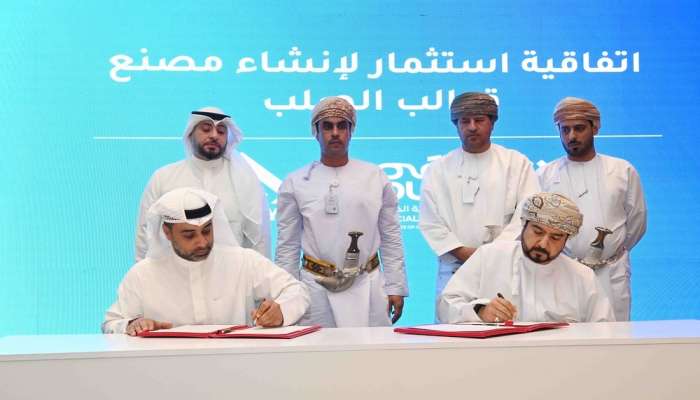
Muscat: The Public Authority for Special Economic Zones and Free Zones (Opaz) signed investment agreements to establish a group of new projects in the Special Economic Zone at Duqm (Sezad), Salalah Free Zone, and Khazaen Economic City.
The investment agreements stipulate the establishment of projects across several key economic sectors, including electric vehicle batteries, specialised steel, cement and pipe manufacturing plants, as well as glue production, tile cutting and processing, in addition to a pharmaceutical warehouse.
The agreements reflect Opaz’s efforts to attract new investments and localise a range of high value projects that contribute to economic diversification and enhance the added value of Oman’s industries, in line with the goals of Oman Vision 2040.
Qais Mohammed Al Yousef, Chairman of Opaz, affirmed that the signing of these agreements, with a total investment value exceeding OMR200 million, represents an important step toward enhancing economic diversification across the governorates and reinforcing Oman’s position as a regional hub for high-quality investments.
Al Yousef explained that these projects, spanning vital sectors across various economic, free, and industrial zones, reflect the confidence of both local and international investors in the competitive investment environment offered by these zones.
He added that the Authority continues to develop an integrated system of incentives, flexible regulations, and modern infrastructure in a way that enhances the added value of national industries, supports the localisation of advanced technologies, and creates sustainable business opportunities, in line with the objectives of Oman Vision 2040.
The Chairman of Opaz further noted that these agreements are an extension of ongoing efforts to attract high-quality investments and strengthen strategic partnerships, emphasizing that the coming phase will witness an acceleration in the implementation of industrial projects with high economic impact.
Dr. Said Khalifa Al Quraini, Director General of Investment Development at the Authority, stated that the economic and free zones have become among the key economic enablers, driven by flexible regulations, attractive investment incentives, and the ease of establishing businesses, along with continuous support provided by the Authority and the zones to investors at all stages of the investment journey—from project establishment through to post-commercial launch (“aftercare” services). He emphasized that partnership with investors is one of the core priorities of the Authority.
He further noted that recent years have seen noteworthy efforts to attract new investments, which has been positively reflected in investment statistics and data, showing that the total investment volume in the zones rose to OMR22.4 billion by the end of last year, recording a growth of 6.8% compared to 2024.
The signed investment agreements include the establishment of a steel mould manufacturing plant in the Special Economic Zone at Duqm by Alshaya Group, with investments amounting to OMR41 million and a production capacity of around 306,000 metric tonnes annually in Phase I.
Eng. Ahmed Ali Akaak, CEO of the Sezad, said the new project is a qualitative addition to steel-related projects being implemented in the zone by several global companies, commending Alshaya Group’s decision to select the Sezad for its investment.
Meanwhile, Abdul Latif Mohammed Alshaya said the decision to establish the project in Duqm was driven by its strategic location as a multi-sector industrial hub connected to Duqm Port overlooking the Arabian Sea and the Indian Ocean, as well as its integrated industrial infrastructure and attractive investment incentives.
He added that Duqm offers structural cost advantages and logistical flexibility, placing the project in a strong position to benefit from future green hydrogen initiatives.
He explained that the project aims to meet the growing demand for steel moulds in the region, driven by construction and infrastructure activity, while also reducing imports and increasing ICV.
He further noted that the new industrial facility will rely on Electric Arc Furnace (EAF) technology, which has lower carbon intensity compared to traditional steel production.
The project is expected to commence commercial production in 2028, with output reaching 306,000 tonnes in the first year, rising to 342,000 tonnes annually by 2030.
An investment agreement was also signed during the ceremony to establish a project for the manufacturing of active anode materials used in lithium batteries for electric vehicles in the Salalah Free Zone, with an investment of OMR35 million.
The project will be developed by GFCL EV Advanced Materials and represents the company’s second investment in the electric vehicle sector in the Salalah Free Zone, following last year’s agreement to establish a project for advanced chemical materials for electric batteries.
Dr. Ali Mohammed Tabouk stated that the signing of this agreement represents a qualitative strategic step that strengthens the position of the Salalah Free Zone as a regional hub for advanced industries, particularly in the fields of clean energy and electric vehicle technologies.
He added that attracting a project of this scale—with an investment of OMR90 million and spanning more than 186,000 square metres—demonstrates their ability to compete globally and reflects investors’ confidence in the efficiency of the investment environment, the integration of infrastructure, and the clarity of their direction toward high value-added industries.
This project comes within a growing investment ecosystem, as the total cumulative investment volume of active projects in the Salalah Free Zone has reached approximately OMR4.5 billion. Industrial projects account for around 93% of total investments, which confirms a strategic focus on developing an advanced industrial base supported by integrated commercial and service activities that enhance operational efficiency and sustainability.
He also noted that the company’s expansion through launching its second project reflects the success of their model in building long-term partnerships and reinforces their position as a reliable platform for the growth of global investments, particularly within supply chains related to electric vehicle industries.
Khazaen Economic City signed four new investment agreements reflecting its continued attractiveness as a quality investment destination in manufacturing and pharmaceutical industries, with total investments of over OMR12.8 million.
The first agreement involves the establishment of a glue production plant and a specialised unit for tile cutting and processing, with investments of OMR6 million by Al Fadan International.
The second agreement covers the establishment of a plant specialised in infrastructure products, site development and cement works, with an investment of OMR5 million by Al SUMMITS for Trading and Industry.
The third agreement is for the establishment of an advanced pharmaceutical warehouse by Overseas Investment at a cost of OMR1.2 million.
The fourth agreement is for the establishment of a plastic pipe manufacturing plant producing polyethylene (PE) and polyvinyl chloride (PVC) pipes, with an investment of OMR600,000 by Virgent Forest Trading, signed by Tie Hao Zhang, General Manager of the company.
Eng. Salim Suleiman Al Thuhli, CEO of Khazaen Economic City said that Khazaen continues to attract quality investments that enhance its position as an integrated business environment ready to support investor success, noting that these agreements add value by diversifying economic activities, strengthening supply chains, and increasing industrial value addition.
He added that the projects reflect growing confidence in the business environment within the city and reinforce its role in supporting sustainable industrial development and attracting quality investments.
The Public Authority for Special Economic Zones and Free Zones also signed a memorandum of cooperation with Majan Gulf Investment aimed at structuring three investment opportunities worth more than OMR110 million, studying project requirements, and allocating suitable spaces for implementation. The company plans to develop a number of economic and investment projects within the zones under Opaz’s supervision.




