Tuesday 20 / October / 2026
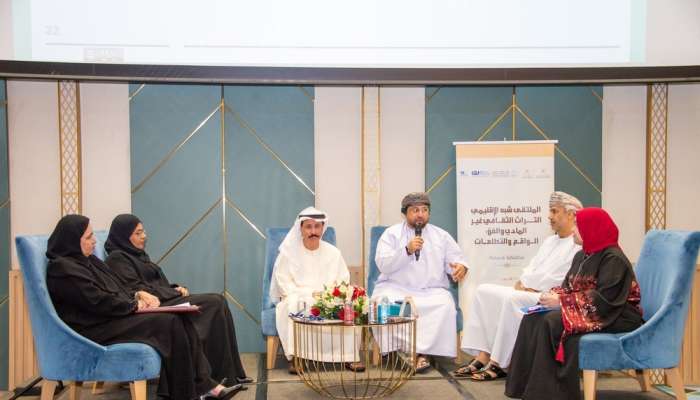
Muscat: The activities of the “Sub-Regional Forum on Intangible Heritage and Art: Reality and Challenges” began in Muscat on Tuesday.
The forum aims to enhance the role of fine art in safeguarding intangible cultural heritage and to explore ways and measures that can contribute to preserving its elements.
The forum opened under the auspices of Sayyid Said Sultan Al Busaidi, Undersecretary of the Ministry of Culture, Sports and Youth for Culture.
The two-day forum targets academics, researchers, and specialists in the fields of intangible cultural heritage and the arts.
It is organised by the Ministry of Culture, Sports and Youth, alongside the Ministry of Education represented by Oman National Commission for Education, Culture and Science, in cooperation with the German University of Technology in Oman (GUtech), represented by the UNESCO Chair on World Heritage Management and Sustainable Tourism in the Arab Region.
Dr. Mahmoud Abdullah Al Abri, Secretary-General of Oman National Commission for Education, Culture and Science, delivered a speech pointing to the launch by the International Council on Monuments and Sites (ICOMOS) on 18 April 2025, of the theme “Emergency Response for Living Heritage in the Context of Crises and Disasters,” emphasising the importance of protecting tangible and intangible heritage from the impacts of crises and disasters.
He stressed that art represents a creative medium for documenting historical landmarks, customs, traditions, knowledge, and cultural practices, as well as transmitting them to future generations.
He highlighted the challenges facing this type of heritage and noted the presence of cultural elements inscribed on the lists of UNESCO’s 2003 Convention under the List of Intangible Cultural Heritage in Need of Urgent Safeguarding.
He also pointed out the role of male and female teachers in nurturing students’ talents and strengthening their connection to their cultural identity. Concluding his speech, he referred to the Sultanate of Oman’s efforts in safeguarding this heritage by inscribing 18 Omani cultural elements, both individual and joint, on UNESCO’s Representative List of the Intangible Cultural Heritage of Humanity, in addition to establishing the UNESCO Sultan Haitham Prize for Safeguarding Intangible Cultural Heritage in 2026.
The opening ceremony of the forum included a series of scientific papers. The first paper was titled “The Role of Sultan Haitham Prize for Intangible Cultural Heritage in Enhancing the Sultanate of Oman’s Civilizational Standing,” presented by Maryam Nasser Al Kharboushi, Director of the Cultural Identity Department at the Ministry of Culture, Sports and Youth.
In the second paper, Aseela Saif Al Manji from Sultan Qaboos University addressed the topic “The Funerary Dan Art in Mirbat Wilayat in Dhofar Governorate: An Ethnomusicological Reading and Miniature Archival Design,” while Dr. Awatif Said Al Ghafri presented the artistic pairing project between Muscat and North Al Batinah Governorates for emergency response to living heritage during crises and disasters.
Sayyid Said Sultan Al Busaidi, Undersecretary of the Ministry of Culture, Sports and Youth for Culture, toured the accompanying exhibition, which featured fine artwork by students participating in the artistic pairing initiative between UNESCO-affiliated schools in Muscat and North Al Batinah Governorates.
The initiative aims to employ fine arts in safeguarding living heritage and promote the exchange of expertise among teachers and supervisors within professional learning communities.
The exhibition also included photographs of the winners of the regional competition “Impact in the Neighbourhood,” organised by the UNESCO Chair on World Heritage Management and Sustainable Tourism in the Arab Region at the German University of Technology in Oman.
The programme for the first day of the forum included a working session titled “The Role of Art in Safeguarding Intangible Cultural Heritage at the Sub-Regional Level,” moderated by Dr. Younis Jamil Al Nu’amani, Director of the Heritage and Culture Department at the Omani National Commission for Education, Culture and Science.
Academics, experts, and specialists in intangible cultural heritage from UNESCO, ALECSO, and the GCC participated in the session.
Discussions centered on UNESCO’s vision regarding the sustainability of living heritage safeguarding within its spatial contexts, periodic reporting on intangible cultural heritage in the Arab region: reality and aspirations, employing art in safeguarding cultural heritage in the State of Qatar, and oral history: experiences and documentation on the International Day for Intangible Cultural Heritage in the United Arab Emirates.
The opening of the forum was attended by several officials from the Ministry of Education and the Ministry of Culture, Sports and Youth, as well as experts and specialists in intangible cultural heritage from UNESCO, ALECSO, and GCC countries.
It is worth noting that the forum comes in conjunction with the celebration of the International Day for Intangible Cultural Heritage, which falls on 17 October each year.