Thursday 02 / April / 2026
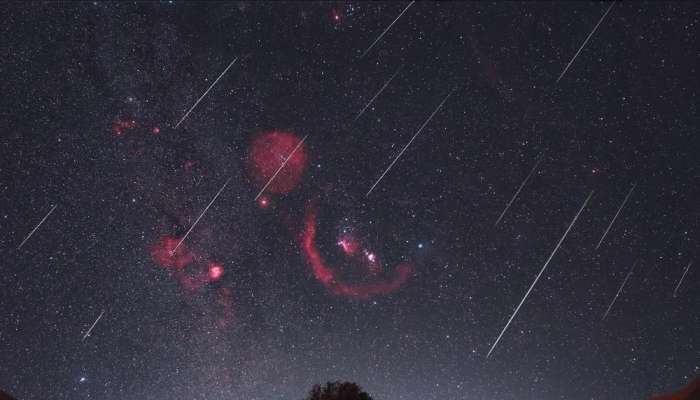
Muscat: The skies of the Sultanate of Oman are set to witness the Quadrantid meteor shower tomorrow evening and during the early hours of the following day. The Quadrantids are among the most active annual meteor showers and coincide with the beginning of the new Gregorian year.
Wisal bint Salem Al Hinai, Vice President of the Community Outreach Committee at the Omani Society for Astronomy and Space, stated that the Quadrantid meteor shower is distinguished by its intense activity and very short peak period, which lasts only a few hours. Under ideal observing conditions, up to 120 meteors per hour may be visible.
She explained that the source of the Quadrantids is linked to the celestial object known as 2003 EH1, a near-Earth object classified astronomically as an asteroid. Its dynamic characteristics indicate that it is likely the remnant of an ancient comet that gradually lost its activity over time.
Discovered in 2003, the object follows a highly elongated orbit around the Sun, completing one cycle approximately every 5.5 years. This orbit exposes it to extreme temperature variations throughout its journey.
Al Hinai noted that the particles associated with the Quadrantid meteor shower are denser and more solid than the debris of many active comets. This explains the shower’s notable brightness and its brief peak, as the dust stream is narrow and highly concentrated.
She added that Quadrantid meteors are characterized by their high speed and striking brightness, often appearing bluish-white in color. Some meteors may leave short-lived smoky trails that persist for a few seconds before fading.
The radiant point of the Quadrantid shower is located near the constellation Boötes, gradually rising during the night and reaching its optimal height just before dawn. Accordingly, the period from midnight until dawn is considered the best time for observation.
Al Hinai pointed out that this year’s peak coincides with the full moon, resulting in increased sky brightness that may hinder the observation of faint meteors. Strong moonlight reduces contrast, making only the brightest meteors visible to the naked eye.
Nevertheless, she emphasized that observing a number of Quadrantid meteors remains possible, particularly the brighter ones with long trails. Viewing conditions may improve when the moon is low near the horizon or when observers look in directions away from its position in the sky.
She explained that the Quadrantid meteor shower can be observed with the naked eye without the need for specialized equipment, provided that observers choose dark locations away from light pollution, allow sufficient time for their eyes to adapt to darkness, and scan wide areas of the sky rather than focusing on a single point.
Al Hinai concluded by noting that the meteor shower coincides with the appearance of several bright winter stars in Oman’s sky, as well as the visibility of some planets with varying colors and brightness. This adds an aesthetic dimension to the experience, creating a celestial scene that blends the steady glow of stars with the swift, fleeting motion of meteors.