Thursday 12 / February / 2026
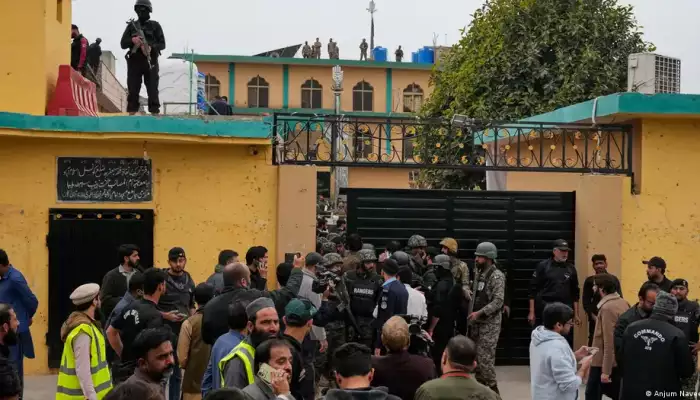
A suicide bombing targeting a mosque in Pakistan's capital, Islamabad, on Friday once again put the spotlight on the precarious security situation in the South Asian nation.
The blast killed at least 31 people and injured 169 others.
Hussain Ali, 34, and his brother were at the mosque when the attack occurred.
"People started running and screaming, scattered in all directions. There was smoke and blood all over the floor and on the prayer mats. I lost my brother Abbas in the incident," Ali told DW.
The regional Islamic State affiliate, known as Islamic State in Pakistan, claimed responsibility for the attack.
It was the deadliest incident in Islamabad since a 2008 suicide bombing at the Marriott Hotel killed 63 people and wounded more than 250.
Deteriorating security
The latest attack comes as Prime Minister Shehbaz Sharif's government struggles to tackle a surge in militant attacks across the Muslim-majority country.
"Pakistan is currently facing grave internal security challenges from various factions of the Pakistani Taliban and the Islamic State Khorasan Province (ISKP)," said Ihsanullah Tipu Mehsud, an Islamabad-based security analyst.
"The TTP has a larger number of fighters, a wider territorial presence, more advanced weapons and carries out more sophisticated propaganda," he explained.
"It also has continuous safe havens across the border in Afghanistan, multilayered revenue generation mechanisms and more access to the local populace compared to ISKP," the expert added.
The ISKP, on the other hand, presents an unpredictable threat despite its smaller size, due to its difficult-to-trace and rapidly evolving operational tactics, Mehsud said.
"The ISKP is very resilient and, despite suffering immense losses in recent years in both Afghanistan and Pakistan, continues to carry out its operations."
'We will not spare them,' says Pakistani minister
Authorities, however, reject claims that the state is losing control, pointing to numerous disrupted plots and ongoing intelligence-led operations.
They also cite the arrest of several suspects allegedly involved in plotting and carrying out the latest attack.
"We have arrested the facilitators of the blasts within hours, and we will fight them to end terrorism in our country. We will not spare them," Talal Chaudhary, Pakistan's state minister for interior, told DW.
Pakistan's President Asif Ali Zardari blamed Afghanistan's ruling Taliban for the deteriorating security in the region.
He said that the Afghan Taliban have created conditions "similar to or worse than" those before the September 11, 2001, attacks targeting the United States.
Pakistan's Defense Minister Khawaja Mohammad Asif said the bomber who carried out the attack on the Shiite mosque had a history of traveling to Afghanistan. He noted that the incident signaled that Pakistan-based militants operating from Afghanistan could strike even in the capital.
The minister also blamed neighboring India for sponsoring the assault, without providing evidence.
India's Foreign Ministry condemned the mosque attack and rejected allegations of its involvement as "baseless."
Afghanistan's Foreign Ministry also refuted allegations that Kabul offers refuge to militants launching attacks in Pakistan.
How to improve the security situation?
Imtiaz Gul, executive director of the Center for Research and Security Studies, said the situation is unlikely to improve unless the Pakistani government "takes all political parties and stakeholders on board."
"This requires a distribution of trust, rather than expanding the security apparatus," he told DW.
Mehsud shares a similar view.
"To effectively address the current volatile law and order situation," he stressed, "Pakistan needs to balance military power with soft power like improved governance, service delivery in marginalized regions, and bridging the existing state-society gap."
"The country also needs to use a combination of force and diplomacy to change the Afghan Taliban's stance on anti-Pakistan militant outfits," he added.