Thursday 22 / October / 2026
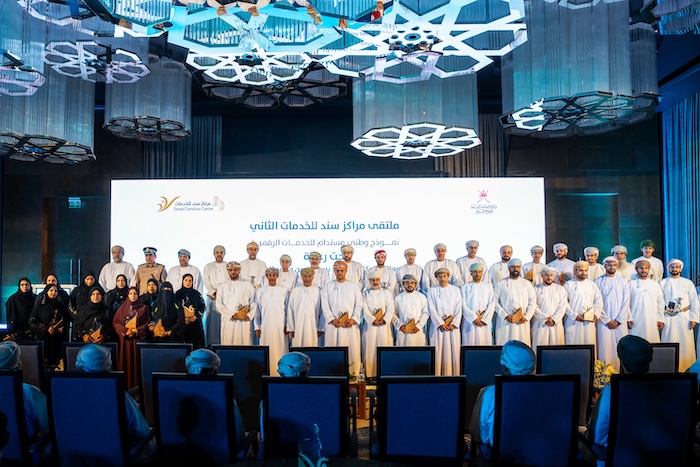
Muscat — The Ministry of Commerce, Industry and Investment Promotion (MoCIIP) held today the Sanad Services Centres 2nd Forum under the auspices of H.E. Dr. Khamis bin Saif Al Jabri Chairman of Oman Vision 2040 Implementation Follow-up Unit, and in the attendance of H.E. Qais bin Mohammed Al Yousef, Minister of Commerce, Industry and Investment Promotion, along with a several of Their Excellencies, representatives of government and private entities and owners of Sanad Services Centres.
H.E. Dr Saleh bin Said Masan, MoCIIP Undersecretary for Commerce and Industry and Chairman of the Supervisory Committee for Sanad Services Centres, said that the Sanad Services Centres 2nd Forum represents a national platform shedding light on the experience and journey of Sanad Services Centres across the Sultanate of Oman, while also showcasing future directions for their development and the enhancement of their institutional sustainability.
He added that Omani youth are the country’s true wealth, and that investing in their skills and capabilities is an investment in a brighter future. He noted that the MoCIIP is working diligently to provide an enabling environment that allows them to achieve their ambitions and contribute effectively to national development.
Meanwhile, Nasra bint Sultan Al Habsi, Director General of Commerce at the MoCIIP, affirmed that Sanad Services Centres is considered a key pillar in developing the trade and services ecosystem in the Sultanate of Oman, given their pivotal role in facilitating commercial procedures, improving the business environment, and supporting entrepreneurs and small and medium enterprises. She noted that the General Directorate of Commerce continues to strengthen integration with Sanad Centres and expand the range of services provided, contributing to improved performance efficiency and a more flexible, high quality service experience for beneficiaries.
The forum underscored the importance of partnerships with government and private sector entities in enhancing service efficiency and improving the beneficiary experience. Its organisation aligns with digital transformation goals and the priorities of Oman Vision 2040.
The opening ceremony programme included a visual presentation reviewing 20 years of work by Sanad Services Centres and their national role in delivering government and private services, alongside another presentation highlighting the ministry’s efforts to develop these centres and strengthen their presence among the public and the wider community, through a lab held in December 2025.
The ceremony also seen the signing of five cooperation programmes with government and private entities to enhance partnerships and support the Sanad Services Centres ecosystem, the launch of four initiatives aimed at developing and improving service quality for beneficiaries and supporting the transition towards a more efficient business environment, as well as the recognition of Sanad Services Centre owners who have continued operating their centres for 20 years.
Towards strategic goals
Mohammed bin Salim Al Mashaikhi, Director of the Sanad Services Centres Department at the MoCIIP, stated that the forum reflects the spirit of partnership and integration, strengthens the centres’ efforts to deliver high quality services to the community, supports the sustainability of the centres, and creates job opportunities. He noted that this contributes to a positive impact on the business environment in the Sultanate of Oman. He added that the organisation of the forum comes within the framework of enhancing the MoCIIP’s goals to ensure the sustainability of Sanad Services Centres and to achieve effective coordination between the centres and various government entities.
He pointed out that since their establishment in 2006, Sanad Services Centres have developed their service ecosystem and expanded the scope of their operations to become an effective link between government entities and the community. The count of electronic transactions completed annually has surpassed 1,000,000 transactions through over 900 service centres, providing approximately 2,350 job opportunities for Omani youth.
He emphasised that celebrating 20 years of contribution is not merely a commemoration, but a milestone to renew commitment to delivering high quality services and expanding impactful initiatives that strengthen effective partnerships with all relevant entities and meet the evolving needs of society.
Meanwhile, Manar bint Ali bin Rashid Al Kalbani, owner of a Sanad Services Centre, affirmed that centre owners play an active and direct role in developing services and various initiatives. She noted that their participation in the lab contributed to presenting practical ideas, testing new solutions, and enhancing the beneficiary experience, which positively reflected on improving service quality and efficiency.
She added that the ongoing partnership between centre owners and the Ministry of Commerce, Industry and Investment Promotion reflects a spirit of cooperation and collective commitment, positioning Sanad Centres as true platforms for innovation and excellence in service delivery, ensuring their sustainability and strengthening their leading position in the Omani market.
Cooperation programme agreements
The forum seen the signing of five cooperation programmes by the Ministry of Commerce, Industry and Investment Promotion with government and private entities, aimed at developing and enhancing the quality of services provided to beneficiaries and supporting the transition towards a more efficient business environment.
H.E. Dr Saleh bin Said Masan, Undersecretary of the Ministry of Commerce, Industry and Investment Promotion for Commerce and Industry, signed a cooperation programme with H.E. the Undersecretary of the Ministry of Transport, Communications and Information Technology for Communications and Information Technology. The programme provides a general framework for linking the Unified Electronic Services Portal with the Sanad Services Centres portal. He also signed a cooperation programme with H.E. the Secretary General of the Supreme Judicial Council to link the council’s services with the Sanad electronic portal.
In the banking sector, H.E. Al Masan signed a cooperation programme with H.E. the Chairman of the Board of Directors of the Development Bank to link the bank’s services with the Sanad electronic portal, in addition to signing a similar agreement with the CEO for Government Banking Services at Bank Dhofar.
The agreements also included the private sector, with the signing of a cooperation programme with the Acting CEO of Leading Technology Company (Aqari Platform – FrontTech) to link the company’s services with the Sanad Services Centres electronic portal.
Fathi bin Nasser Al Mahamouli, Assistant Director of Sanad Services Centres at the MoCIIP, explained that signing these cooperation programmes contributes to developing the Sanad Services Centres ecosystem, builds trust in Omani youth, and assigns a wide range of services to them, placing them under significant responsibility to preserve previous achievements and maintain high efficiency in the next phase. This, in turn, contributes to increasing employment opportunities within the centres.
Several initiatives launched
The initiatives reflect the MoCIIP’s commitment to developing Sanad Service Centres as integrated service hubs. Several initiatives were launched, including the On the Job Training Initiative in cooperation with the Ministry of Labour, which aims to provide over 1,000 job opportunities for Omani youth, develop their practical skills, and prepare them for the labour market in line with its needs.
The Sanad Service Centres Excellence Award in the governorates was also launched to recognise outstanding centres, encourage positive competition, and raise performance and quality standards across the governorates of the Sultanate of Oman.
Other initiatives included the launch of the Munjiz Card, which provides a practical solution for completing transactions with government and private entities through authorising Sanad Services Centres, thereby accelerating procedures and facilitating beneficiaries’ access to services. In addition, the Centres Classification Initiative was launched to enhance performance quality, raise levels of excellence, and establish clear standards for professional development within the centres, supporting sustainability and encouraging continuous innovation.
Exciting success journey
During the forum, the Ministry of Commerce, Industry and Investment Promotion honoured centres that have continued operating since their establishment 20 years ago, in recognition of their sustained and distinguished services to citizens and beneficiaries, and their contribution to developing the business environment and government services in the Sultanate of Oman.
The recognition also included government and private entities that have supported the Sanad Service Centres journey by providing services through the centres and contributing to enhancing performance quality and facilitating procedures for beneficiaries. Former administrations of Sanad Services Centres were also honoured in appreciation of their pivotal role during the establishment phase and for laying the regulatory and technological foundations that helped create an integrated working environment and ensured the centres’ success over the past two decades.
Azhar bint Zahran Al Yahmadi, Project Manager of the Sanad Services Centres Forum at the Ministry of Commerce, Industry and Investment Promotion, confirmed that this step comes in appreciation of the efforts exerted over the past years and to highlight the fruitful partnerships that have supported the Sanad Centres journey. She noted that the recognition reflects a spirit of cooperation and joint action among various entities and motivates continued innovation and service improvement.
She added that the recognised centres represent a model of commitment to excellence and sustainability, contributing to the completion of more than one million transactions annually through over 900 centres and providing approximately 2,350 job opportunities for Omani youth, thereby strengthening their role in community empowerment and supporting the national economy.
Sanad Services Centres Lab
The forum reviewed the outcomes of the Sanad Services Centres Lab through a visual presentation highlighting the lab’s work, its various phases, and the strategic outcomes aimed at strengthening the sustainability of Sanad Centres, improving the quality of services provided, and enabling them to fulfil their role as a nationally accredited channel for delivering government services. This aligns with the goals of Oman Vision 2040 and keeps pace with government digital transformation trends.
The lab’s outcomes resulted from a collaborative effort involving the Ministry of Commerce, Industry and Investment Promotion and a number of relevant government entities. The work focused on addressing regulatory, operational, and technical challenges, and on developing an integrated model that balances digital transformation with direct service delivery, enhancing the efficiency of the centres and their economic and social sustainability.
The outcomes emphasised the importance of transitioning Sanad Centres from a traditional service delivery model to a nationally governed operational system with clear governance. This includes centre classification, performance measurement, and linking results to incentives, contributing to an improved beneficiary experience and stronger institutional trust in the centres.
The lab adopted a sustainability roadmap based on five integrated phases. It begins with the Establishment and Organisation Phase, which focuses on unifying regulatory frameworks and strengthening institutional relations with government entities. This is followed by the Empowerment and Readiness Phase, aimed at enhancing centre readiness and building the capabilities of owners and staff. The Expansion Phase then focuses on diversifying services and strengthening operational partnerships, followed by the Measurement and Quality Improvement Phase, which concentrates on assessing performance, service quality, and beneficiary experience. The roadmap concludes with the Incentives and Sustainability Phase, which links performance to incentives and ensures the continuity and growth of the centres.
The lab’s outcomes were structured around four main pillars, each playing a complementary role in achieving sustainability:
Sanad Services Centres Quality Pillar: Focuses on enhancing institutional and service performance quality through stronger governance, centre classification, human capacity building, and improved beneficiary experience.
Services Pillar: Concerned with developing the range of services delivered through Sanad Centres and strengthening their role as an accredited channel for government and private services, increasing attractiveness and efficiency.
Incentives and Facilitation Pillar: Aims to create a motivating operational environment by linking performance to incentives, supporting job stability, and promoting positive competition among centres.
Enablers Pillar: Focuses on preparing the supportive legislative, regulatory, and technical environment, strengthening digital integration, activating complaints and feedback channels, and building community trust.
Dialogue session to study outcomes
As part of the Sanad Services Centres 2nd Forum, a specialised dialogue session was held to present and analyse the outcomes of the Sanad Services Centres Lab. The session aimed to institutionalise the lab as a continuous, practical track and to move from the stages of experimentation and diagnosis to effective implementation, contributing to the sustainability of the centres and the enhancement of service quality.
The session addressed the overall framework of the lab’s work, the strategic drivers behind its launch, and the real world challenges it tackled. It also highlighted the methodology that distinguished the lab from previous development models, through its focus on participatory analysis of challenges and linking solutions directly to practical implementation.
The discussion further explored the concept of incentives and facilitation as tools to support outstanding performance, linking commitment and quality to motivation, in addition to reviewing the regulatory, technical, and legislative enablers that will support the implementation of the lab’s outcomes and facilitate the work of the centres in the coming phase.
The session concluded with a joint discussion on the post lab phase and the tangible impacts that Sanad Service Centre owners can expect in the near term. This helped clarify the implementation pathway and reaffirmed that the lab’s outcomes mark the beginning of a sustainable phase of action rather than the end of a development journey.
This session forms part of the Ministry of Commerce, Industry and Investment Promotion’s efforts to strengthen the role of Sanad Service Centres as a nationally accredited channel for delivering government services, in support of the goals of Oman Vision 2040, particularly in service quality and institutional sustainability.
20 Years of giving
Sanad Services Centres are celebrating this year 20 years of excellence and contribution in delivering integrated services to citizens and investors, marking a distinguished journey of achievements and meaningful contributions to the development of the business environment and government services in the Sultanate.
Since their establishment, Sanad Services Centres have worked to simplify procedures and provide innovative solutions for beneficiaries, serving as an effective bridge between government entities and the community, with a strong focus on quality, efficiency, and excellence in performance. Over the past two decades, the centres have launched qualitative initiatives and programmes that support small and medium enterprises and facilitate access to services for all segments of society.
This milestone reflects the pioneering role played by Sanad Centres in promoting a culture of service excellence and developing innovative operational mechanisms in line with Oman Vision 2040, reaffirming their ongoing commitment to supporting the national economy and enhancing beneficiary satisfaction.